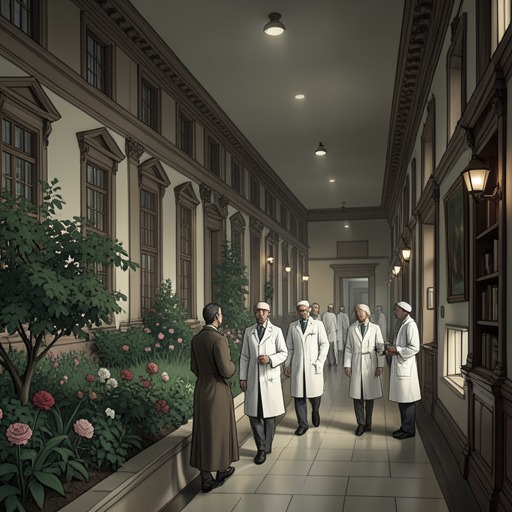
Baryton’s departure from the asylum
Journey to the End of the NightBaryton’s departure from the asylum is a rupture in the life of an institution built around his long, methodical authority. A passage from Macaulay’s History of England brings his dissatisfaction with that life to a crisis; he resolves to leave for England, appoints Ferdinand Bardamu to manage the asylum in his absence, and entrusts its practical and laboratory work to Serge Parapine. His departure is at once an escape he insists is final and a transfer of responsibility whose consequences fall on those he leaves behind.
Background and Turning Point
For more than thirty years, Baryton had made the asylum his life’s work, tending its administration with an intensity that had once seemed inseparable from his identity. By the time of his departure, however, he had withdrawn from its daily affairs and relied on Parapine to manage them. His growing inward confusion was visible even as he tried to conceal it in public, and he had become increasingly reluctant to be disturbed.
The immediate turning point comes through a reading assignment. At the start of their studies, Baryton and Bardamu had read Macaulay’s sixteen-volume History of England too quickly for Baryton’s satisfaction. Baryton orders them back to it, chapter by chapter. When they reach the passage about Monmouth’s failed venture—his uncertainty about what he is doing and his desire to escape—Baryton reads and rereads it, closes the book, and recites the passage from memory. The episode gives his own hesitation a literary counterpart: the text does not merely occupy him but seems to expose the uncertainty already gathering around his decisions.
Baryton is seized with vertigo by what he sees in Monmouth’s predicament: the absurdity and tragedy of human nature. The narrator presents the moment as a break in continuity. Until then, only a tenuous thread had connected Baryton to the common life around him; now, Bardamu says, that thread snaps. Baryton has not yet explained his destination, but the reading scene prepares the departure as more than a change of residence: it is his rejection of the life and work that had held him in place.
Baryton Announces His Departure
Late that night, Baryton summons Bardamu to his office. Bardamu expects a major decision affecting his employment, such as dismissal, but learns instead that Baryton intends to leave. He describes himself as someone of settled habits, near old age, whose career had been devoted to patient and scrupulous work. Yet he says that, within a few months, he has turned away from all of it and feels detached and exhilarated by the prospect of beginning again. His past, he declares, has ceased to exist; he is going away, fleeing, escaping.
Bardamu tries to soften the decision by suggesting that the journey might be a temporary holiday, a welcome interval after which Baryton could return refreshed to his post. The attempt briefly touches Baryton’s pride, but it does not change his resolve. Baryton says that forty years of prudent smallness have left him drained, stultified, and defeated. What he wants, he explains, is to get away from the burden of his former self, to be alone and at peace. His language gives the departure its central contradiction: he seeks freedom by breaking with the accumulated identity and obligations that have defined him, not by reforming his familiar life.
The institution’s future makes the break concrete. When Bardamu asks what will happen to it, Baryton appoints him director for the duration of his absence. The clientele, he expects, will accept Bardamu; Parapine will handle the machinery and laboratory. Baryton adds that he no longer believes anyone’s presence is indispensable, a marked change from the earlier investment that made the asylum his life’s work. His confidence in the practical arrangement does not erase the upheaval: the people left behind must keep the establishment running while its founder abandons it.
Arrangements and Farewell
Baryton has considered the professional and personal repercussions. He is troubled by how competing practitioners in nearby places might interpret his voluntary exile, and by the difficulties his daughter Aimée may face. He is leaving her in the care of an aunt in the provinces, whom he regards as a stranger. Once his private affairs are settled, Bardamu and Parapine will be responsible for looking after his interests and property as best they can. The departure therefore involves not only the institution but a redistribution of practical duties and care.
Asked where he is going, Baryton answers that he is bound for England. The next day, Bardamu and Parapine help him with his luggage. His unfamiliarity with travel procedures is apparent when the passport’s pages and visas surprise him and he asks whether he can obtain several spare passports. Near departure, he is still uncertain whether to take hard or soft collars, and how many of each. These decisions nearly carry the three men to the time of the train.
Baryton takes only a small suitcase, intending to travel light and remain mobile. On the platform, he hesitates before the high steps of the international train; Bardamu and Parapine help him aboard. He has a second-class ticket and remarks, “First is no better,” a practical observation that briefly restores his familiar manner. They shake hands. The whistle sounds, the train pulls out with a jolt, and the noise cuts across their farewells. Baryton has time to say, “Good-bye, boys!” before his hand slips from theirs and becomes a diminishing figure in the smoke and darkness.
Aftermath and Significance
The narrator admits that they are, in one sense, not sorry to see Baryton go, yet the house feels empty without him. His manner of leaving makes them sad despite themselves; the departure feels unnatural, and they are left wondering what will happen to them. The mixed response captures the cost of a break that is at once desired by Baryton and destabilizing to the people and institution he abandons.
The episode’s movement from a familiar reading routine to a sudden break, then from a declaration of escape to the small logistics of collars, passports, tickets, and handshakes, holds Baryton’s grand resolution against ordinary practical life. His departure is not presented as a completed renewal: the evidence establishes his intention and destination, but not what he will find in England or whether he will return. What it does establish is that the asylum’s founder has withdrawn his claim to indispensability, leaving Bardamu and Parapine to sustain the institution after the authority around which it had been organized has gone.